Thai is the national language of Thailand, spoken by around eighty percent of the sixty million residents of the South-East Asian country.
Linguists consider it an “uninflected, primarily monosyllabic, tonal language” in the “Tai-Kadai family.” The spoken language is believed to
have originated in the area which is now the border between Vietnam and China, an idea which provides clues to the origin of the Thai
people, an area of continued scholarly debate. Linguistically, the language is related to languages spoken in eastern Burma (Myanmar), northern
Vietnam, Yunnan, and Laos.
The written Thai Language was introduced by the third Sukhothai period king, Ramkhamhaeng, in 1283. This writing system has undergone little
change since its introduction, so inscriptions from the Sukothai era can be read by modern Thai scholars. The writing was based on Pali,
Sanskrit, and Indian concepts, and many Mon and Khmer words entered the language.
Much like
L'Academie Française, there is a governing body for the Thai language, the
Royal Institute ราชบัณฑิตย์สถาน

,
which publishes an official
Thai dictionary
and adds new words to the language as required, possibly drawing on Pali, Sanskrit, Mon, and Khmer, for example.
Regional variation
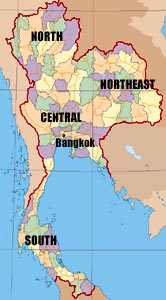
Within Thailand, there are four major dialects, corresponding to the southern, northern (“Yuan”), northeastern (close to Lao language), and
central regions of the country; the latter is called
Central Thai or
Bangkok Thai and is taught in all schools,
is used for most television broadcasts, and is widely understood in all regions. Nowadays, English is also taught in all public schools.
There are a few minor Thai dialects such as Phuan and Lue, spoken by small populations. Also within Thailand, small ethnic minority groups
(including so-called “hill tribes”) account for around sixty languages which are not considered related to Thai.
The four primary dialects of Thai should not be confused with four different “languages” used by Thais in different social circumstances.
For example, certain words are used only by Thai royalty, creating a royal language. There are also languages used for religious figures,
polite everyday interactions, and gruff or crude communications.
Alphabet and tones
The Thai language uses a
phonemic alphabet of fourty-four
consonant and fifteen basic vowel
graphemes. The latter are
assembled into about thirty-two
vowel combinations. In Thai writing, characters are horizontally placed, left to right, with no
intervening space, to form syllables, words, and sentences. Vowel graphemes are written above, below, before, or after
the consonant they modify, although the consonant always sounds first when the syllable is spoken. The vowel graphemes (and a
few consonants) can be combined in various ways to produce numerous compound vowels (diphthongs and triphthongs).
All
syllables must contain a vowel sound, but may begin and/or end
with a consonant sound. A syllable which ends in a vowel sound is called
open, and a syllable which ends in a consonant is called
closed. Each syllable is pronounced in one of five
lexical tones: mid, high, low, rising, or falling; as a result, speaking correctly creates
pleasing melodic patterns which has led the language to sometimes be called a
sing-song language by foreigners.
Unlike the Chinese language, the Thai
alphabet is
phonemic, so pronunciation of a word is independent of its meaning
(English is also an alphabetic language). Because of this, it is possible to pronounce a word without knowing its meaning. On
the other hand, as mentioned above, like Chinese and around half of the world's languages (not including English), Thai is a
tonal language.
The use of tones in Thai is
lexical, meaning that each word has a certain pitch characteristic with which it must be spoken to be properly understood. The Thai
language uses five
tones: mid, low, high, rising, and falling. More details can be found
here.
Each syllable, consisting of one or more
consonants and a simple or compound
vowel (possibly
inherent or implied, and thus
not written) has a
tone determined by several factors, including the type and presence of consonants (consonants are divided into
three
classes for this purpose), the vowel duration, and the presence of one of four
tone marks. Some people incorrectly
assume that the tone marks identify all necessary tones, or perhaps force certain tones, but neither of these is correct.
Actually the final tone of a syllable is determined by the tone mark in conjunction with factors mentioned above.
Grammar
Because it lacks
inflectional morphology, the grammar of the Thai language might be considered simpler than grammar in Western
languages, and for many students, this makes up for the additional difficulty of the tones. Most significantly, words are not modified or conjugated
for tense, person, possession, number (singular/plural), gender, or subject-verb agreement.
Determiners such as
a,
an, or
the are not used, so
linguistic definiteness is expressed in other ways, but most often left
underspecified. Most Thai words are a simple single immutable syllable. Thai words are
assembled into larger forms by compounding;
particles and other
markers—such as for
aspect—are added to fine-tune the meaning. In this way,
tense, politeness, verb-to-noun conversion, and other linguistic objectives are accomplished with the addition of modifying words to the basic
subject-verb-object word order.
Of the world's languages, Thai has one of the richest systems of grammatical
aspect; the language allows for very detailed elaboration of how
events transpire and progress. Because English has a relatively impoverished system of aspect, this can make it difficult to translate sentences such as
ปีติกำลังจะเริ่มกินข้าวเสร็จไป ("Piti is going to start to finish eating the rice.").
Cultural Aspects
As you will surely notice when speaking Thai people, they “greatly appreciate puns and double-entendres which, besides enlivening everyday vernacular, spice and propel outrageous dialogue in
popular art forms such as folk theatre.” A particular four-syllable rhyming pattern is prevalent in many Thai words and sayings (see
Language » Elaborate Expressions for examples), and many other compound
words use prefixes or suffixes where the purpose seems only to be euphony.
Learning Thai
Many westerners do not make time to learn
written Thai, focusing instead only on speaking. One problem with this approach is that the various
reference materials you will accumulate each use a different
transcription scheme (
phonemic spelling with a western alphabet),
and it thus becomes difficult to recognize connections between your multiple sources of information. Although only
you can decide
whether to make the extra effort to study Thai script, I think it can provide a valuable and rewarding foundation for continued
learning of the Thai language.
Some beginning students are intimidated by the initricacies of
register mentioned briefly above—that is, language variation according to situation or social context.
Registers of Thai include royal, ecclesiastical, rhetorical, elegant, radio/television broadcast, and common street language.
This is not a problem, however, since the usages are fairly elastic, and foreigners may be allowed more leeway, since the effort to speak Thai is
widely appreciated. There are many ways to say “I” or “you,” for example, but those used by royalty or ecclesiastics won't be of concern to the beginner.