Pronouncing the Tones
Tone refers to a change in the pitch of a syllable during its pronunciation.
In Thai, every syllable is pronounced in one of five tones:
low,
mid,
high,
falling, or
rising. The tone must be spoken correctly for the intended meaning of a word to be
understood. Since every word has a particular mandatory tone, we say that the Thai language has obligatory
lexical tone.
Every Thai word throughout this website is displayed alongside its
phonemic transcription. If you
haven't changed the default settings, then this "transliteration" indicates the required tone for the word with a
superscripted capital letter after each syllable;
L,
M,
H,
F, or
R, corresponding
to the
low,
mid,
high,
falling, and
rising tones, respectively.
Linguistic marking
Languages have at their disposal various different tools for achieving their primary function of enabling communication; any sound or gesture that
a human can produce is fair game. Taking these tools together we can think of them as
marking resources, which different
languages embrace (or eschew) in different ways.
Comparing Thai and English,
prosody is used for different functions. In Thai,
tone has a
semantic function; words which are similar but pronounced with different
tones have different, unrelated meanings. English generally does not use tone in this way, but for illustration it may be useful
to examine a different type of
prosody in English. Consider the case of
stress. In a few rare cases, English differentiates the
meaning of words with lexical stress: consider "He wanted to
present her with the medal of honor..." versus
"...but she wasn't
present to receive it."
More commonly in English though,
stress is applied
at the
sentence level for
information-structural effect—that is, in order to differentiate the
topic of the sentence (information which is already
accommodated by discourse participants) from its
focus (the new information that the proposition intends to communicate).
In other words, stress in English is typically used to call attention to the most important part of the utterance.
Consider the following English, where stressed syllables are shown in bold.
[Paul]FOCUS fell in the swimming pool.
Paul [fell in the swimming pool.]FOCUS
The first sentence answers the question, "Who fell in the swimming pool?" The second sentence answers the question,
"Why is Paul all wet?"
Pronouncing the five lexical tones
| Speaking the Five Tones of Thai |
|---|
| tone |
example word |
how to say it |
| low |
 ไข่ ไข่  |
khaiL (egg) |
 |
spoken in a constant or slightly falling lower pitch, starting at a pitch lower than your normal vocal range. |
| mid |
ไป |
bpaiM (to go) |
 |
spoken in a constant pitch in your normal vocal range. Do not vary the pitch as the syllable is pronounced. |
| high |
ครับ |
khrapH ([a grammatical particle]) |
 |
spoken at the top of your normal vocal range, producing a somewhat stressed sound. |
| rising |
หนัง |
nangR (cinema film) |
 |
rising sound, as in a question spoken in English |
| falling |
ใช่ |
chaiF (yes, agreement) |
 |
starting slightly above comfortable speaking range, rise just a little before falling below the starting point. |
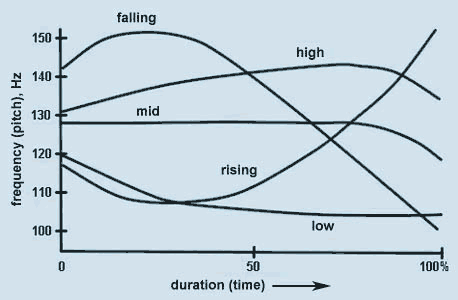
The following image shows a more technical analysis of the pitch (frequency) of over time.
Unless you are exclusively studying the Thai script, it is very important
to note, learn, and speak the proper tones (shown as superscripted capital letters — L M H R F — in the
phonemic transcriptions throughout these web pages).
Technical note for advanced students:
A minority view that some linguists take is that the high tone is further divided into two tones, giving
a total of six
tones in the Thai language. As the graph shows, the high tone has a short drop-off in pitch near its end. The proposed
additional tone is a shorter-duration high tone which does not descend like this. McFarland (Thai-English Dictionary, Stanford University Press, 1944, page x) calls this the "high staccato"
tone, as opposed to the "circumflex or emphatic" tone (which we call "high"). Others argue that this distinction is covered by the
long-versus-short characteristic of Thai vowels—in other words, by viewing the high tone on dead syllables as though it didn't have time to fall off.
Since this subtlety is not represented in the phonemic transcriptions on our site, once again the best plan is to be guided by a native Thai speaker or our
audio clips.